Wole Soyinka’s masterpiece, alongside works by al-Hakim, Yacine, Fugard, and Kani, explores profound themes of cultural collision and individual destiny.
Context of Wole Soyinka’s Play
Wole Soyinka, a Nobel laureate, penned “Death and the King’s Horseman” as a direct response to a real event in colonial Nigeria during 1944. This pivotal moment involved the intervention of a British colonial officer who prevented an Elesin Oba – a king’s horseman – from completing a ritual suicide.
The play isn’t merely a historical recounting; it’s a powerful exploration of cultural misunderstanding and the damaging effects of colonial interference. Soyinka positions his work alongside other significant postcolonial dramas, like those by Tawfik al-Hakim and Athol Fugard, examining themes of identity and resistance. The play’s context is crucial for understanding its complex layers.
Overview of the Play’s Central Conflict
The core conflict in “Death and the King’s Horseman” revolves around the clash between Yoruba tradition and British colonial rule. Elesin Oba is obligated to commit ritual suicide to accompany his deceased king into the afterlife, maintaining cosmic balance.
However, Pilkings, the District Officer, misunderstands the ritual’s significance and intervenes, arresting Elesin. This act disrupts the spiritual order and sets in motion a tragic chain of events. The play explores the consequences of imposing foreign values and the resulting disruption of a deeply rooted cultural practice, mirroring conflicts found in works by other playwrights.

The Historical and Cultural Background
Soyinka’s play draws from a real event in colonial Nigeria, deeply rooted in Yoruba cosmology and the vital connection between the living and the dead.
The Yoruba Tradition of Ritual Suicide
Central to understanding “Death and the King’s Horseman” is grasping the Yoruba belief system surrounding death and transition. Ritual suicide, specifically by the Elesin Oba, wasn’t viewed as a tragic ending, but a necessary act of cosmic balance.
The Elesin, through his willing death, accompanied the departed king to the afterlife, ensuring the king’s smooth passage and, crucially, the continued well-being of the community. This act wasn’t born of despair, but of profound honor and duty, a sacred obligation to maintain harmony between realms. It was a highly formalized, ritualized process, steeped in tradition and overseen by community elders.
The Elesin Oba’s Role and Responsibilities
The Elesin Oba, or King’s Horseman, held a uniquely powerful and sacred position within Yoruba society. He wasn’t merely a royal attendant, but a vital link between the living and the deceased king. His primary responsibility was to accompany the king’s spirit to the afterlife, a journey demanding immense courage and spiritual fortitude.
This transition required a carefully orchestrated ritual suicide, undertaken with dignity and acceptance. The Elesin enjoyed considerable privilege during his final days, indulging in desires and receiving tributes, preparing himself for his ultimate duty. His actions directly impacted the community’s fate, making his role profoundly significant.
Colonial Intervention and its Impact
The arrival of British colonial forces, represented by Pilkings, dramatically disrupts the established order and the sacred ritual. Viewing the Elesin’s intended suicide as barbaric, Pilkings intervenes, attempting to prevent it based on his understanding of law and order.
This intervention isn’t simply a matter of differing legal systems; it embodies a fundamental clash of cultures and a colonial imposition of values. Pilkings’ actions demonstrate a profound misunderstanding of Yoruba beliefs and the spiritual consequences of disrupting the ritual, ultimately leading to tragic and far-reaching repercussions for all involved.

Key Characters and Their Significance
Central figures like Elesin, Pilkings, Iyaloja, and Olunde embody conflicting ideologies and cultural perspectives, driving the play’s complex narrative.
Elesin Oba: The King’s Horseman
Elesin embodies the weight of tradition and the sacred duty to accompany his king into the afterlife. He is a figure of immense power and ritual significance within Yoruba society, yet also deeply human with desires and vulnerabilities.
His impending ritual suicide is not viewed as a tragic death, but as a necessary completion of a cosmic order, ensuring the continued well-being of his people.
However, Elesin’s hesitation and ultimate failure to fulfill his obligation disrupt this order, leading to devastating consequences and questioning the very foundations of his culture. He represents a clash between personal desire and collective responsibility.
Pilkings: The District Officer
Pilkings represents the imposing force of British colonialism and its often-misguided attempts to impose order upon a culture it doesn’t understand. He embodies a rigid adherence to law and a belief in the superiority of Western values.
His intervention to prevent Elesin’s ritual suicide stems from a place of perceived moral obligation, yet it fundamentally disrespects Yoruba traditions and disrupts the spiritual balance.
Pilkings’ actions, though intended to be benevolent, demonstrate the damaging consequences of cultural imperialism and the arrogance of colonial power, ultimately fueling the play’s central conflict.
Iyaloja: The Mother of the Market
Iyaloja is a powerful and commanding figure, representing the collective voice and moral authority of the Yoruba community, particularly its women. She fiercely defends the traditions and spiritual beliefs of her people against colonial interference.
Her sharp wit and direct confrontation with Pilkings highlight the cultural chasm between the colonizers and the colonized.

Iyaloja embodies the strength and resilience of Yoruba culture, and her unwavering commitment to Elesin’s duty underscores the importance of ancestral obligations and communal harmony.
Olunde: Elesin’s Son
Olunde, Elesin’s son, returns to Ilujinle from England, where he studied medicine, embodying a bridge between two worlds. He represents a younger generation grappling with the complexities of tradition and modernity, and the impact of colonial education.
His experiences fighting in World War II provide a stark contrast to the ritualistic suicide his father is preparing for, questioning the value of one life against another.
Olunde’s ultimate act serves as a tragic commentary on duty and sacrifice, surpassing even his father’s intended fulfillment of tradition.

Themes Explored in the Play
Soyinka’s play delves into the profound clash of cultures, duty versus desire, the damaging nature of colonialism, and the question of predetermination.
Clash of Cultures
“Death and the King’s Horseman” vividly portrays the dramatic collision between Yoruba traditions and British colonial rule. The play isn’t simply a conflict of cultures, but a struggle over meaning and the right to define reality. Pilkings, representing the colonial administration, fundamentally misunderstands – and therefore disrespects – the deeply spiritual significance of Elesin’s ritual suicide.
This misunderstanding stems from a Western worldview that cannot comprehend a tradition rooted in ancestor worship and cosmic balance. Soyinka highlights how colonial intervention isn’t merely political, but an imposition of a foreign epistemology. The play forces audiences to confront the ethical implications of cultural imperialism and the devastating consequences of imposing one’s beliefs onto another society.
Duty, Honor, and Tradition
Central to “Death and the King’s Horseman” is the intricate web of duty, honor, and tradition that governs Yoruba society. Elesin Oba’s impending ritual suicide isn’t a personal choice, but a sacred obligation to maintain cosmic order and ensure the king’s successful transition to the afterlife. His honor, and the well-being of his people, depend on fulfilling this ancestral duty without faltering.
The play explores the weight of these expectations and the devastating consequences when tradition is disrupted. Elesin’s failure to complete the ritual isn’t merely a personal failing, but a disruption of the spiritual equilibrium, threatening the entire community. Soyinka examines the profound responsibility inherent in upholding cultural practices.
The Nature of Colonialism
“Death and the King’s Horseman” powerfully critiques the nature of colonialism and its destructive impact on indigenous cultures. Pilkings, representing British colonial authority, embodies a profound misunderstanding – and disrespect – for Yoruba traditions. His intervention, driven by a misguided sense of moral superiority, disrupts a deeply significant ritual, revealing the arrogance and cultural insensitivity inherent in colonial rule.
Soyinka demonstrates how colonialism doesn’t simply impose political control, but actively seeks to dismantle and redefine the cultural foundations of colonized societies. The play exposes the damaging consequences of imposing foreign values and the tragic consequences of cultural interference.
Fate vs. Free Will
“Death and the King’s Horseman” intricately explores the complex interplay between fate and free will, particularly through Elesin’s struggle. Is his ritual suicide a predetermined destiny, a necessary act to maintain cosmic balance, or does he possess agency in his final moments? The play doesn’t offer easy answers.
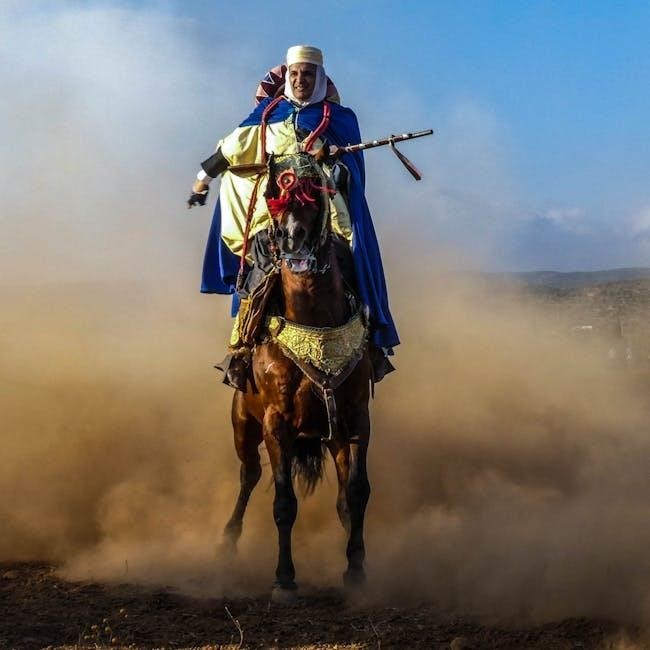
Elesin’s hesitation and eventual failure to complete the ritual raise questions about individual responsibility and the power to alter one’s fate. Olunde’s death, a consequence of colonial intervention, further complicates this debate, suggesting a tragic disruption of both individual and collective destinies.

Symbolism and Motifs
Soyinka’s play utilizes rich symbolism; the market embodies life’s vibrancy, while the Horseman represents kingship and the cyclical nature of existence and duty.
The Market as a Symbol of Life
The bustling market in “Death and the King’s Horseman” transcends a simple commercial space, functioning as a potent symbol of life’s vibrant energy and communal spirit. It represents the continuity of Yoruba culture, brimming with activity, negotiation, and the everyday rhythms of existence.
Iyaloja, the Mother of the Market, embodies this life force, acting as a crucial link between the spiritual and material realms. The market’s lively atmosphere sharply contrasts with the solemnity surrounding Elesin’s impending ritual, highlighting the value placed on earthly life.
Soyinka masterfully uses the market to showcase the resilience and interconnectedness of the Yoruba people, even in the face of colonial disruption and impending tragedy. It’s a space where tradition thrives and resistance subtly manifests.
The Horseman as a Representation of Kingship
Elesin Oba, the King’s Horseman, isn’t merely an individual; he embodies the very essence of kingship and the continuity of the Yoruba royal lineage. His ritual suicide isn’t a personal act, but a sacred duty ensuring the stability of the kingdom and a smooth transition between rulers.
The Horseman’s attire, bearing, and ceremonial role all signify his connection to the departed king and his responsibility to maintain cosmic balance. His death is a necessary sacrifice, mirroring the king’s own journey into the afterlife.
Soyinka portrays Elesin as a figure of immense dignity and power, whose actions resonate far beyond his individual fate, impacting the entire community and its spiritual well-being.
Clothing and its Symbolic Meaning
Throughout “Death and the King’s Horseman,” clothing functions as a potent symbol of status, cultural identity, and the disruption caused by colonial intervention. Elesin’s elaborate attire signifies his elevated position as the King’s Horseman and his connection to the spiritual realm.
Conversely, the British officers’ uniforms represent colonial authority and a rigid, foreign order. Pilkings’ appropriation of Yoruba garments—particularly the gele—is a blatant act of disrespect and cultural misunderstanding.
Soyinka utilizes clothing to visually highlight the clash between Yoruba tradition and British imperialism, emphasizing the symbolic violence inherent in colonial rule and the erosion of indigenous customs.

Dramatic Structure and Style
Soyinka’s play blends Yoruba ritual and poetic language with a Western tragic form, creating a unique theatrical experience exploring complex cultural conflicts.
Use of Yoruba Language and Rituals
Soyinka masterfully integrates Yoruba language and elaborate rituals into the fabric of “Death and the King’s Horseman,” enriching the play’s authenticity and cultural depth. These elements aren’t merely decorative; they are integral to understanding the worldview and spiritual beliefs underpinning the narrative.
The incorporation of orin (poetry) and ijala (chanting) alongside specific ceremonial actions, like the offering of kola nuts, provides a window into Yoruba cosmology. This linguistic and ritualistic immersion challenges the audience to engage with a different cultural logic, moving beyond a solely Western perspective.
The play’s power resides in its ability to showcase these traditions, not as exotic curiosities, but as vital expressions of a complex and deeply rooted culture.
The Play’s Tragic Form
“Death and the King’s Horseman” adheres to classical tragic conventions, yet subverts them through a postcolonial lens. The play builds towards an inevitable catastrophe stemming from a fatal flaw – Elesin’s momentary hesitation – and external forces, namely Pilkings’ intervention.
However, unlike traditional Western tragedies, the source of suffering isn’t solely individual. It’s deeply intertwined with the clash of cultures and the disruption of a cosmic order. The tragic outcome isn’t simply Elesin’s death, but the fracturing of a spiritual and communal balance.
Olunde’s sacrifice further complicates the tragic structure, highlighting the play’s exploration of duty and honor.
Soyinka’s Poetic Language
Wole Soyinka’s masterful use of language elevates “Death and the King’s Horseman” beyond a simple dramatic narrative. His writing blends Yoruba poetic traditions with Western dramatic forms, creating a unique and powerful style. The play is rich in imagery, metaphor, and rhythmic prose, mirroring the ritualistic and ceremonial aspects of the story.
Soyinka skillfully incorporates Yoruba proverbs and chants, lending authenticity and depth to the cultural context; This poetic density isn’t merely ornamental; it’s integral to conveying the play’s complex themes and emotional weight.

Critical Reception and Analysis
Initial reactions to Soyinka’s play sparked debate, while postcolonial interpretations continue to illuminate its enduring relevance and complex cultural dynamics.
Initial Reactions to the Play
Upon its debut, “Death and the King’s Horseman” ignited considerable controversy, particularly regarding its depiction of Yoruba ritual suicide. Some Western critics initially struggled with understanding the cultural context, viewing the practice as barbaric or simply tragic.
However, others recognized Soyinka’s powerful exploration of clashing worldviews and the disruptive impact of colonialism. The play’s complex structure, blending Yoruba traditions with Western dramatic conventions, also drew varied responses.
Early analyses often centered on the ethical dilemmas presented, questioning the intervention of Pilkings and the consequences of disrupting a deeply ingrained cultural practice. These initial reactions laid the groundwork for subsequent, more nuanced interpretations.
Postcolonial Interpretations
Postcolonial scholarship has significantly reshaped understandings of “Death and the King’s Horseman,” viewing it as a potent critique of colonial power dynamics. The play is now widely analyzed as a representation of the psychological and cultural damage inflicted by imperialism.
Critics highlight how Pilkings’ intervention isn’t merely a misunderstanding, but an assertion of colonial authority and a denial of Yoruba agency. The play’s tragic outcome is seen as a consequence of this imposed worldview.
Furthermore, interpretations explore Soyinka’s deliberate use of Yoruba language and ritual to reclaim and celebrate indigenous culture in the face of colonial suppression.
The Play’s Relevance Today
“Death and the King’s Horseman” continues to resonate deeply with contemporary audiences, prompting crucial conversations about cultural understanding and the legacies of colonialism. Its exploration of clashing values remains strikingly relevant in a globalized world often marked by intercultural conflict.
The play’s themes of duty, honor, and the weight of tradition invite reflection on individual responsibility within societal structures. Moreover, the questions it raises about agency and free will in the face of external pressures are timeless.
Ultimately, Soyinka’s work serves as a powerful reminder of the importance of respecting diverse cultural practices and challenging systems of oppression.

“Death and the King’s Horseman” PDF Resources
Finding reliable PDF versions of Soyinka’s play requires careful source evaluation, ensuring academic integrity and avoiding copyright infringements online.
Availability of Online PDFs
Numerous websites offer “Death and the King’s Horseman” as a PDF download, ranging from university course pages to general ebook repositories. However, the legality and quality of these sources vary significantly. Some PDFs may be scans of copyrighted material, while others might be poorly formatted or incomplete versions.
Academic institutions often provide access to the play through their digital libraries, requiring student or faculty login credentials. Project Gutenberg, while a valuable resource, doesn’t currently host a verified PDF of this specific play. Caution is advised when downloading from unfamiliar sites, prioritizing those affiliated with educational or reputable organizations to ensure a legitimate and usable copy.
Reliable Sources for PDF Downloads
For legitimate access to “Death and the King’s Horseman” PDFs, prioritize academic databases like JSTOR or university library websites – often requiring institutional access. Online bookstores, such as Amazon or Barnes & Noble, frequently offer digital versions for purchase, guaranteeing a high-quality, legally obtained file.
Google Scholar can lead to open-access PDFs hosted by universities or research institutions. Always verify the source’s credibility before downloading. Avoid websites promising free downloads without clear copyright information, as these may contain malware or violate copyright laws. Purchasing a digital copy remains the most secure and ethical option.
Considerations When Using Online PDFs
When sourcing “Death and the King’s Horseman” PDFs online, exercise caution. Verify the website’s reputation and security protocols to avoid malware or viruses. Check for clear copyright statements; unauthorized distribution is illegal and unethical. Be wary of sites requesting personal information before allowing downloads.
PDF quality can vary significantly. Ensure the document is legible and complete, without missing pages or formatting errors. Cross-reference with known editions to confirm accuracy. Prioritize sources offering previews to assess quality before committing to a full download. Always have updated antivirus software installed.